


Chasing the Stripes: Why May Offers the Best Tiger Sightings of the Year
- May 11
- 4 min read
There is a moment on a May morning at Pench Tiger Reserve when the forest holds its breath.
The safari vehicle has stopped. Your naturalist guide's hand is raised. Somewhere ahead, between two bare teak trunks, a shaft of early light catches something amber and moving. Your pulse climbs. The forest stays perfectly, impossibly still.
This is why you came.
If you have been telling yourself you will do this trip — from Nagpur, from Hyderabad, from Pune, from Indore — May is the month that rewards the decision. Why May Is the Single Best Month for Tiger Sightings at Pench Tiger Reserve
You might assume that the lush post-monsoon months — October, November — offer the richest wildlife experience. In terms of scenery, perhaps. In terms of tiger sightings, the data tells a different story.
By May, the Pench Tiger Reserve's seasonal streams and temporary waterholes have evaporated. What remains is a small network of permanent water sources along the Pench River corridor and within the core zones accessible from the Turia Gate. Every animal in the reserve — tiger, sambar, gaur, wild boar, dhole — converges on these points.
Tigers need water every 24 to 48 hours. This biological necessity strips away the tiger's legendary elusiveness and makes it predictable in a way no other month can produce.
The result: morning safari sighting rates in May regularly exceed 70–80% on core-zone departures from Turia Gate — among the highest in all of Central India.

The Forest in May: Bare, Cinematic, Unforgettable
The May forest at Pench is unlike the jungle of popular imagination.
The teak trees stand stripped of leaves, their enormous pale trunks rising from a floor of copper-gold leaf litter. Sight lines extend 200 metres where they would be blocked in October's green density. The quality of early-morning light — angling between bare trunks, catching dust motes in the still air — creates a landscape so visually dramatic that wildlife photographers consider it the most photogenic season of the year.
And when a tiger moves across an open riverbed in this light, at 6 AM, with the day still cool and the sky still pale — you understand, completely and without any remaining doubt, why people organise their entire year around this. The Kohka Lake Reset: When the Safari Ends and the Real Luxury Begins
Here is what you may not expect: for many guests, the hours between safaris become the part of the trip they talk about longest.
You return from a morning safari at Pench Tiger Reserve by 10 AM. You have seen something extraordinary — a tiger on an open riverbed, a dhole pack moving in formation, a sloth bear ambling through the bare forest in the morning gold. Your nervous system is alive in a way it has not been in months.
And then you arrive back at Aranyaani Resort Pench, and Kohka Lake is waiting.
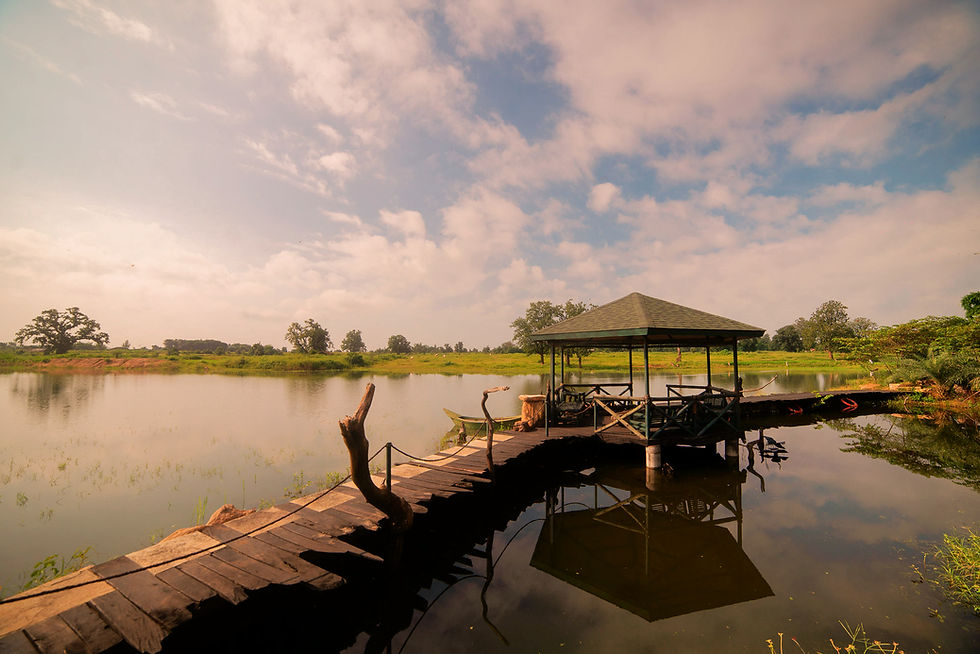
The lake in May carries a particular quality of stillness. The water is glass at this hour. A kingfisher crosses from one bank to the other in a single electric line of colour. The forest on the far bank is reflected perfectly. There is no city noise here — no traffic, no notification, no background hum of collective urgency. Just water, light, and the sound of a forest breathing.
You sit on your private villa terrace and you realise, slowly, that your shoulders have dropped three inches. That your jaw is unclenched. That you are, for the first time in longer than you can precisely identify, genuinely present.
This is the mental reset that Pench — and specifically this lake, this light, this place — produces. It is not metaphor. It is physiology.
Four Reasons a Forest Safari Retreat Resets You Like Nothing Else
Your nervous system responds to nature in minutes, not days. Research in environmental psychology confirms that exposure to green, natural environments begins lowering cortisol within 20–30 minutes. The complete absence of city noise at Kohka Lake accelerates this process. Guests from Nagpur and Hyderabad consistently report that by the second evening, they feel more rested than they have in months.
Safari rhythm imposes healthy structure. The 5 AM wake-up, the forest at dawn, the mid-morning rest, the late afternoon re-entry — this is a schedule that works with your biology rather than against it. Most urban professionals sleep better on the second night of a forest stay than they have in years.
Distance dissolves perspective distortion. The problems that feel architectural from inside a city often reveal themselves, from the edge of Kohka Lake at dusk, to be ordinary and manageable. The forest does not solve your problems. It returns you to a size where they can be solved.
Shared attention creates genuine connection. A tiger sighting is an equaliser. It strips away professional identity, city distance, the performance of busyness. Couples and friends who have been near each other for months often find, in a safari vehicle at 6 AM, that they are genuinely together again. You Are Closer Than You Think
From Nagpur, Aranyaani Resort Pench is 90 km — a two-hour drive, or a Friday evening departure that puts you at the forest's edge before 8 PM.
From Hyderabad or Vijayawada, a short flight into Nagpur and a drive places you here within half a day. From Pune or Mumbai, the journey is equally direct.
May fills up. The core zones close for monsoon by mid-June. The window is real, and it is not long.
The tiger is there. The lake is quiet. The bonfire will be lit.
You have earned this more than you realise. Book your May safari stay at aranyaaniresortpench.com


Comments